AutoBrain: the repair manual, answered out loud
A workshop assistant that reads scanned manuals and answers a technician with the document, page and figure it came from. Our prototype, no customers.
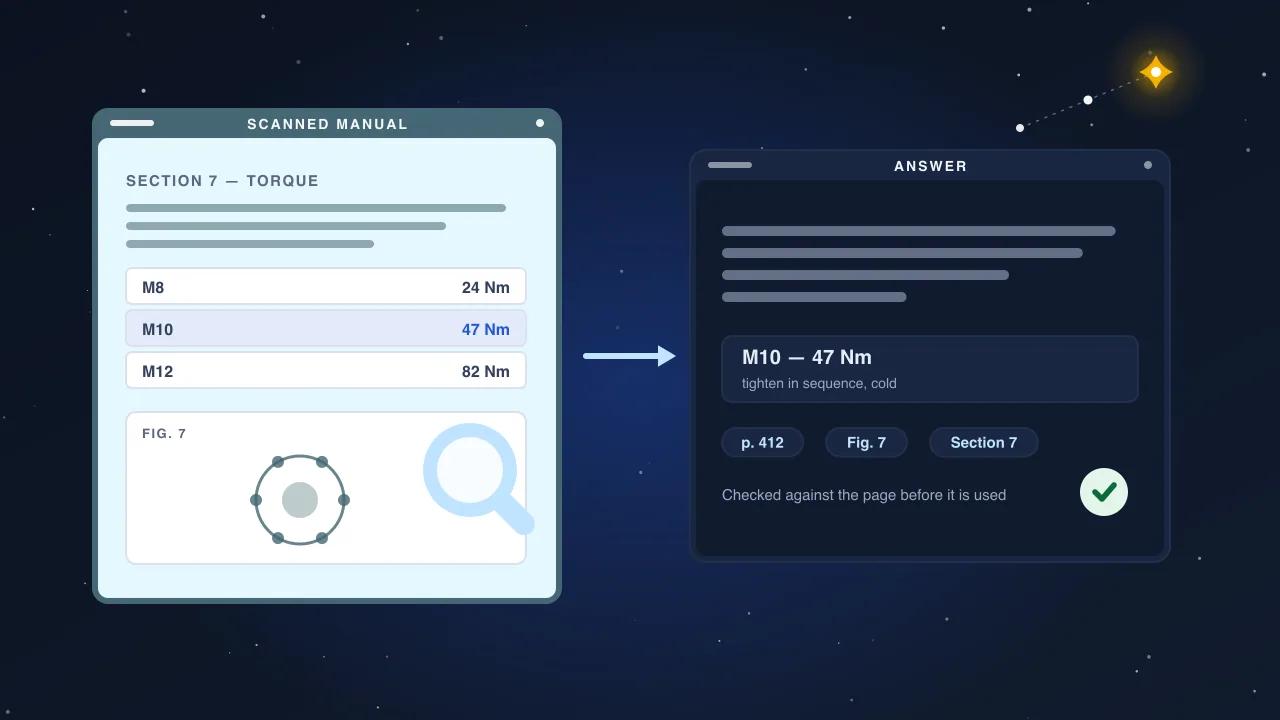
A technician has a car on the lift, a fault code, and a repair manual that exists as a six-hundred-page scan of a printed book. The answer is in there. Finding it costs twenty minutes of a bay that earns money only when it is turning, and the search is done standing up, on a phone, with dirty hands. AutoBrain is Alnitak's own prototype for that problem. It ingests scanned manuals through an OCR-first pipeline — printed pages, tables and diagrams, not clean digital PDFs — and answers a workshop's questions about troubleshooting, procedures and specifications with a citation back to the document, the page and the figure the answer came from. The technician reads the answer, then checks the page it names. The judgement stays where it was. It is a prototype and it is described here as one. No workshop is running it in production, nobody has paid for it, and no time-saved or first-time-fix figure appears on this page, because none has been measured.
What changed, measured
- Scanned printWhat it ingestsPhotographed and scanned manual pages with tables and diagrams, which is the format this knowledge actually exists in, rather than the clean digital PDFs most tools assume.
- Every answerCarries its sourceDocument, page and figure or table, returned with the answer, so the technician verifies before acting rather than trusting a paragraph with no provenance.
- ZeroWorkshops in productionBuilt and demonstrated as a prototype. No customer is running it, and no time-saved, first-time-fix or revenue figure is claimed anywhere on this page.
What it is built to produceBuilt to take the lookup out of a technician's hands without taking the judgement: the answer arrives with the page it came from, so a person checks it before they act on it. Any claim about time saved in a bay would have to be measured against a signed baseline in a real workshop, and no workshop has run it yet.
The knowledge exists and nobody can reach it
Every workshop owns the answer to almost every question it will be asked this year. It owns it as a stack of printed manuals, a shelf of binders, and two or three people who have read enough of them to know roughly where to look.
That is an ergonomic problem before it is a technical one. It is paid for in the time a bay stands still, in the interruption of the one senior technician who knows the page, and in the decisions taken without checking because checking costs twenty minutes.
Scanned, not digital
Most document-question tools assume a clean PDF with a text layer. Repair manuals are not that. They are photographs of printed pages, with torque figures in ruled tables and procedures keyed to exploded diagrams.
So the ingestion pipeline is OCR-first and built around that reality: page images, a primary OCR engine with a fallback, separate table extraction, and figures kept addressable so an answer can point at one.
An answer you can check
The design rule is that the assistant never asks to be trusted. Every answer comes back with the document, the page and the figure it was drawn from.
That is what makes it usable on a car. A technician does not need the machine to be right; they need to be able to see, in seconds, whether it is — and then own the decision themselves. It is the same guardrail we put around clinical documentation and around assistants that answer customers from a client's own records.
What this is, and what it is not
AutoBrain is a prototype Alnitak built to prove the pattern end to end: ingestion, retrieval, citation and a usable interface, with the model providers swappable so nothing depends on one vendor.
It has no customers. It has not been run in a working shop for a season. Everything on this page describes what it does and how it was built, and nothing on this page describes a result, because there is not one to describe yet.
Key Features
- An OCR-first ingestion pipeline built for scanned print — page images, not text layers — with table extraction so a torque specification in a printed grid survives the journey into the index
- Every answer cites the document, the page and the figure or table it came from, so the person acting on it can verify it before touching the car
- Hybrid retrieval, keyword and vector together with an optional reranker, because a part number and a described symptom are two different kinds of question
- Swappable model providers for language, embedding and vision, so a workshop is never locked to one vendor's pricing or one vendor's availability
- Page-parallel background ingestion, so a six-hundred-page manual is processed without blocking the people already asking questions of the ones already loaded
- A service split that survives contact with a real shop: a web app, an API and a retrieval service that can each be scaled or replaced on their own
Business Impact
What AutoBrain demonstrates is the pattern rather than a return: knowledge that a company already owns, locked inside a format nobody can query, made answerable at the moment and in the place the question is actually asked — and answered with its source attached, so a person can still be the one who decides. That pattern is the same one behind voice to document and the assistants we build over a client's own records. It is shown here as a prototype because that is what it is.
Describe one process. We map it before we quote.
Is your team's knowledge locked in manuals, spreadsheets or one person's head? Describe one process as it runs today. You get a written map of what can be automated, what needs a person, and a fixed price for the first step.
Prefer to talk? Message us on WhatsApp