Critical Care Copilot: say the handover, sign the note, leave
Research found the incoming clinician correctly identified 53% of diagnoses at handover. Our product turns the spoken handover into a note they sign.
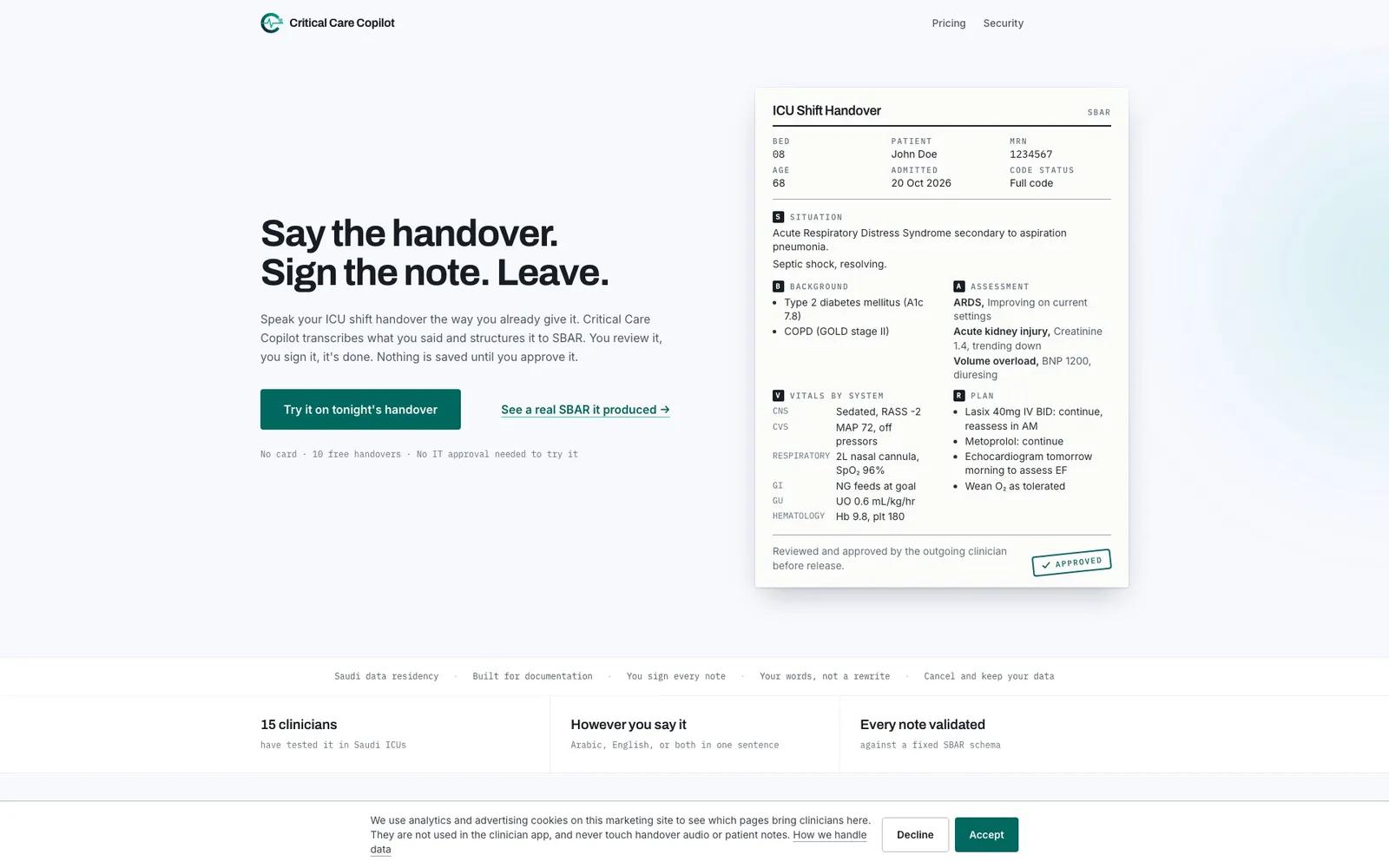
Handover is the moment a patient becomes someone else's responsibility, and it is given out loud and written up later from memory at a desk. Whatever falls out between the bedside and the desk falls out silently. Critical Care Copilot is Alnitak's own product: a clinician speaks the handover they already give, in whichever language they think in, and receives a structured note they review twice and sign before leaving the unit. It transcribes and structures. It never decides. Alnitak built the product, the marketing site, the attribution and funnel instrumentation, and the internal studio the team uses to produce reviewed content.
What changed, measured
- 53% and 40%Diagnoses and treatment goals carried acrossWhat published research found the incoming clinician correctly identified after a handover between staff intensivists. That gap is the entire reason the product exists.
- 15Clinicians tested itOn simulated cases. The proof line is tested with, never used by, and it stays that way until there is stronger evidence to replace it.
- 2Review gates before a signatureNothing reaches the record without a person reading it twice, and a field nobody covered stays visibly empty instead of being filled in fluently.
- 6Funnel events ending in real useThe activation event is a signed handover, not a signup, so the number that gets optimised is the one that means the product was actually used.
- No spend yetPaid acquisition is withheldHeld until the compliance items that gate it are live, so no cost, conversion or adoption figure is claimed. What exists is the system that makes the first dollar accountable.
What it is built to produceBuilt so the registrar giving 20 to 40 handovers a month leaves the unit with a signed record instead of a memory, and so the person who made that record can prove what was said. Adoption is measured by one event, a signed handover, and results will be published against the channel and the post that produced them, when there are results to publish.
The fear, in the clinician's words
Buyer research did not produce a feature list. It produced four sentences, and each one now owns a decision in the product.
Something will be lost in the handoff and I will not know. I will be blamed and cannot prove otherwise. AI will make me worse at my job. It will mangle the English terms inside my Arabic.
So: a field nobody covered stays visibly empty instead of being written fluently, because a confident fabrication is worse than a gap. A full audit trail runs from raw transcript to signed note, so the record defends the person who made it. Differential-diagnosis features were built and then removed, so the product sells typing and never thinking. And a dedicated stage handles English clinical terms inside Arabic speech, because pretending that does not happen is how these tools lose clinicians in the first week.
Why nobody had built it
Published research on handovers between staff intensivists found the incoming clinician correctly identified 53% of diagnoses and 40% of treatment goals. That is not a documentation problem at the margins. That is the core clinical risk of a shift change.
Every ambient scribe on the market documents a doctor-and-patient consultation and produces prose. The handover is a doctor-to-doctor conversation with a fixed structure, and structure is the thing software is good at. Nobody was building for it. That is what a real market gap looks like: not an underserved segment, but a format everyone had walked past.
The buyer with the pain is not the buyer with the budget
The registrar gives 20 to 40 handovers a month, feels every minute of the write-up, and has neither the money nor the authority to buy anything. The consultant with the budget gives four.
That mismatch is the single most useful thing the research produced, and it set three decisions at once: the pricing, the existence of a free tier that the person in pain can start on without asking anyone, and the choice to sell the unit rather than the seat. This is the pattern worth stealing from this page. If the person who feels the problem cannot sign the invoice, the go-to-market has to be designed around that gap, not around a persona document.
What the product refuses to do
Five claims govern every sentence on the site, and any line that supports none of them is cut. Three tone tests and a banned-word list keep the copy from sounding like a vendor. The FAQ was replaced with an objection block, and compliance claims are gated on shipped reality rather than roadmap.
The call to action is built around permission and occasion rather than price: try it on tonight's handover, no card, no approval from anyone. For a professional audience that is the only ask that works, because the thing standing between them and the product is not cost, it is the risk of looking foolish in front of colleagues.
The system was built before the spend
Every posted link goes through a branded route that expands into full attribution: it separates a post we published from a peer passing it on, tells one group conversation from another, and preserves platform click identifiers. Analytics sit behind consent, and conversion events are sent from the browser and the server both.
Six funnel events end in the one that means real use, a signed handover, rather than a signup that flatters the dashboard. Paid was then sized against real cost per click and found unable to be the engine, so the plan holds it for retargeting and a single conference-week burst, and the first twenty habitual users get acquired by hand. That discipline, not a spend number, is the story so far.
Status, stated plainly
Tested with 15 clinicians on simulated cases. Landing, attribution and funnel instrumentation live across three hostnames. Paid acquisition withheld until in-jurisdiction hosting and de-identification are live.
Results will be published when they exist, attributable to the channel and the post that produced them. Until then this page describes a product and a system, and says so.
Key Features
- A voice-to-note pipeline: speech to text, clinical entity annotation, validation against a fixed SBAR schema, two human review gates, and export to Word, PDF and the messaging channel the unit already uses
- A full audit trail from raw transcript through edited draft to signed note, so the record protects the person who made it rather than exposing them
- A dedicated cleanup stage for English clinical terms spoken inside Arabic sentences, because that is how the handover is actually given
- Fields nobody covered are shown empty rather than written fluently, so a gap in the handover stays visible instead of being smoothed over
- Branded campaign links that expand into full attribution, separating a post we published from a peer passing it on
- Consent-gated analytics with conversion events sent from both the browser and the server, and a six-event funnel whose activation event is a signed handover
- An internal studio with clinical, legal and final review gates, a house-style linter and an append-only approval trail, with no path to patient data
- Blue and green releases behind a reverse proxy: continuous integration builds every image and the server never builds
Business Impact
Fifteen clinicians have tested the product on simulated cases. The landing page, pilot page, security page and sample output are live, and every posted link is attributable to a channel, a group and an individual post. Paid acquisition is deliberately withheld until the compliance items that gate it are closed, so no spend, conversion or adoption figure is claimed. What exists today is the system that makes the first dollar of spend accountable, and a product whose four design decisions each answer a fear a clinician said out loud. For an operator reading this page, that is the transferable part: the research decides the product, and the instrumentation is built before the budget.
Describe one task. We look at it before we quote.
Have records that are spoken and then written up later from memory? Describe one process and get a written map of where records are lost, what can be captured from voice, and a fixed price for the first step.
Or describe one task and a person replies within one working day.