One line per statistic, with the number, the source, the date and the kind of study that produced it. Peer-reviewed studies and professional-body surveys come first; vendor and industry figures are at the end and labelled. Last refreshed 13 September 2026.
Handover information loss
- Incoming intensivists correctly identified 53% of diagnoses (454 of 857) immediately after handover. Prospective observational cohort, 352 patient encounters over 44 day-to-night handovers in a thirty-bed tertiary ICU. Critical Care Medicine, 2018.
- Incoming intensivists correctly identified 40% of goals of treatment (123 of 304) after handover. Same study, 95% confidence interval 35 to 46. Critical Care Medicine, 2018.
- Diagnoses and goals of treatment were either not conveyed or not retained in roughly half the cases. The authors' summary of the same cohort; gaps were widest for neurological diagnoses. Critical Care Medicine, 2018.
Structured handover with SBAR
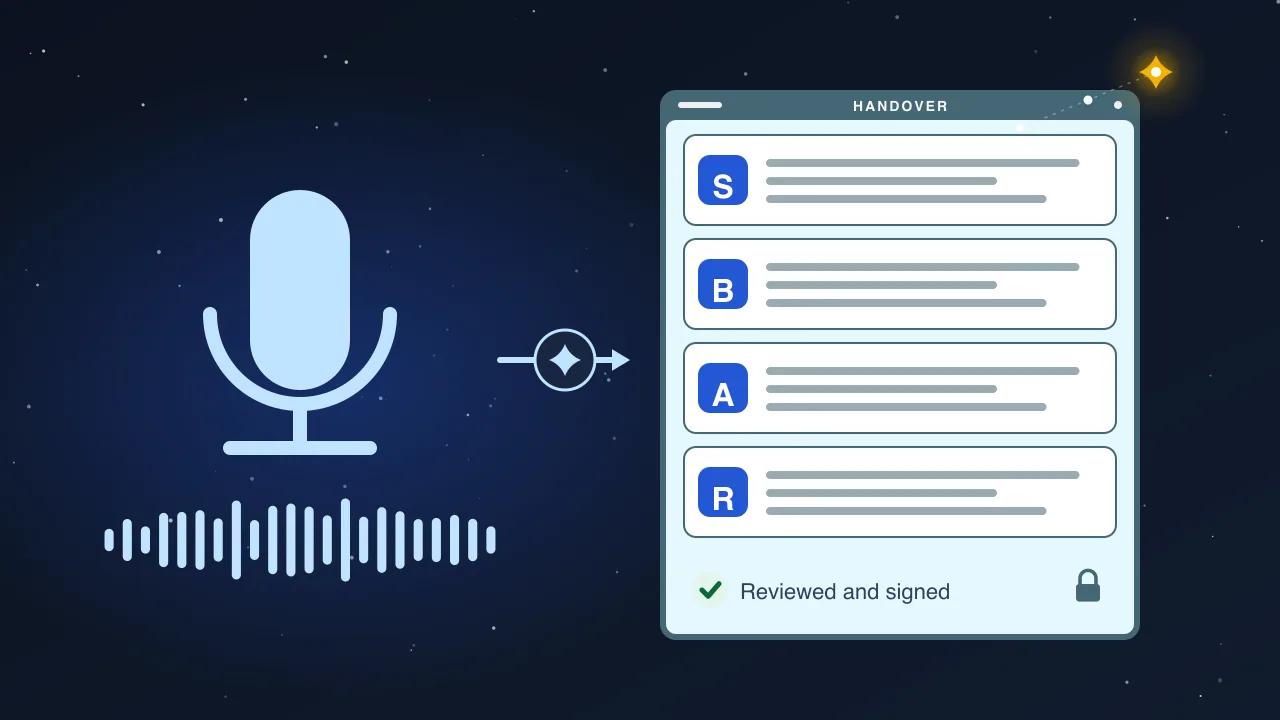
A closed-loop quality-improvement study audited 48 handover events before and 44 after introducing SBAR templates, education, visual reminders and feedback over three weeks. Single centre, no control group, documentation used as the proxy outcome. Cureus, May 2026.
- Documentation of the escalation plan rose from 0% to 97.7%.
- Documentation of response to treatment rose from 2.1% to 79.5%.
- Documentation of urgent issues rose from 4.2% to 100%.
- Documentation of vital signs rose from 16.7% to 86.4%.
- Documentation of the current diagnosis rose from 20.8% to 97.7%.
- Documentation of actions rose from 6.3% to 95.5%.
Bilingual ambient AI scribes
A prospective, single-arm evaluation of a bilingual Arabic-English ambient scribe, published 24 March 2026. Development stage 64 Arabic conversations; implementation stage 55 real consultations (40 Arabic, 15 English) across outpatient, inpatient and primary care in one health cluster; 22 physicians surveyed. Limitations stated by the authors: no comparator, small sample, real-world stage limited to family medicine, evaluators from the same cluster, no systematic safety audit. JMIR Medical Informatics, 2026.
- Arabic notes scored 42.4 out of 45 on a modified PDQI-9 note-quality rubric (standard deviation 1.84) in real consultations.
- The absence-of-hallucination domain scored 4.87 out of 5. Internal consistency scored 4.94 and comprehensibility 4.89.
- 86.4% of surveyed physicians strongly agreed the summaries were comprehensive.
- 86.4% strongly agreed on the potential for time savings; 68.2% strongly agreed on the potential to reduce burnout.
- Arabic notes scored higher than English on organisation (4.60 versus 4.37), while accuracy trended higher in English (4.77 versus 4.53). The accuracy difference did not reach significance.
Physician adoption of AI
- 94% of 3,151 surveyed physicians are using AI in clinical practice or interested in doing so; 54% are currently using it. Professional-body survey. American Medical Association physician survey, March 2026.
- Physician AI use rose from 47% to 63% between spring 2025 and the winter of 2025 to 2026. Physician network survey. Doximity State of AI in Medicine, 2026.
- Voice-based documentation tools such as ambient listening or AI scribes were used by 29% of physicians surveyed in January 2026, up from 20% in April 2025. Same report; literature search was the most common use at 35%. Doximity, 2026.
Documentation burden, vendor and industry figures
- 88% of clinicians identify documentation as their most time-consuming task. Global clinician survey commissioned by a documentation vendor; treat as directional. Press release, 2026.
- At one academic health system, 96% of physicians reported satisfaction with AI-powered documentation tools, with an average reported saving of two hours a day. Reported by a consultancy, single institution, self-reported. SullivanCotter, 2026.
- AI-generated answers appear on about a quarter of web searches in early 2026, and have been available in Arabic since May 2025. Industry estimate for the first figure; Google's own announcement for the second. Relevant to how patients now research clinics. Enrich Labs, 2026; Google, May 2025.
What is deliberately not on this page
No usage or outcome figures for our own product, Critical Care Copilot. Fifteen clinicians have tested it on simulated cases; that is the only line we use until a measured result exists. No figures for any client. No traffic or ranking claims.
How the numbers are used
The requirements that follow from statistics 1 to 9, and from the safety-audit gap in 10 to 14, are worked through in Voice to SBAR: what a safe AI handover tool must do. The clinic-operations side, where statistic 20 matters most, is in A WhatsApp assistant for a clinic.
Revision notes
- 13 September 2026: first version, 20 statistics.